
Summer Porch Reading
about gardens, front of the house, back of the house, vegetables or flowers

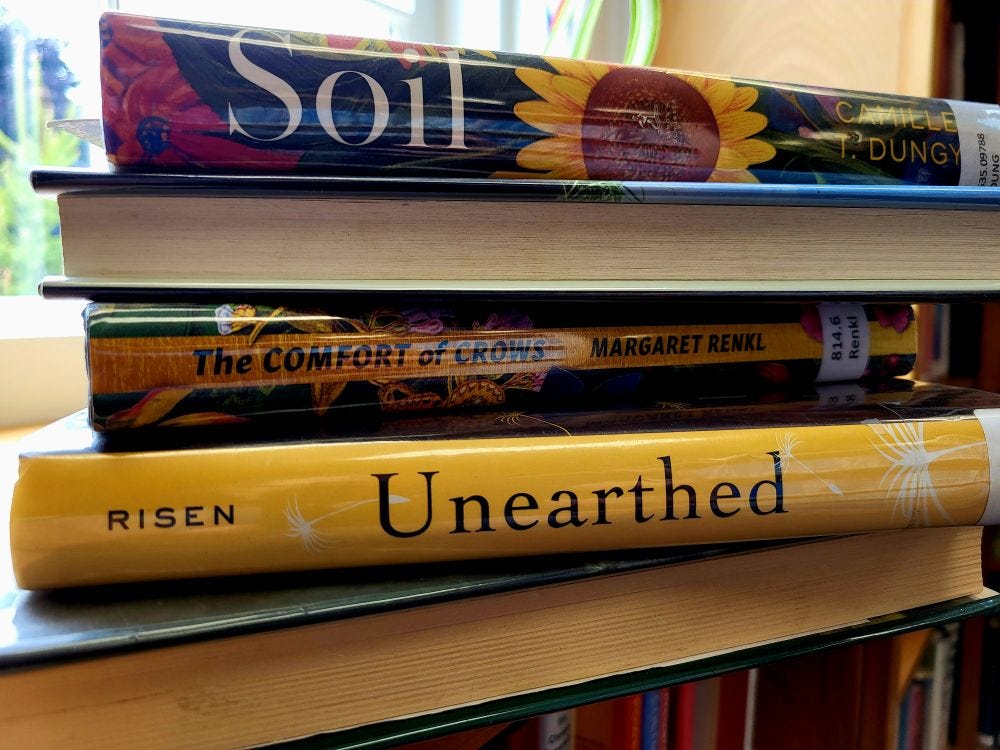
Sometimes, my reading goes down unintended roads driving into themes I was not seeking to explore. That is what happened with several recent books. A frenzied read-a-thon during the shift of seasons. An unconscious window exploration coinciding with the twelve letters I am writing to our brook, the sketch plan, then planting summer vegetables, and the larger place, meaning our homestead, where the forest of trees is yielding, transmuting at the same pace the waving current of flowers, reeds, and marsh-land plants are laying the groundwork for a takeover. Contrasts in two unalike drifts.
Mostly, when I read, I do so with a pen in hand and a journal beside to jot notes, beautiful phrases, research cues, whatever needs a pause for writing reflection—but for the past many months I intentionally seek words, stories with easy, mostly unobjectionable language, and storylines with only a hint of emotional tendencies and rarely jot a note. Instead, stories read on the porch with a glass of iced tea and a plate of cookies. Books to guide me in a nagging question: what is the boundary between too remedial or too technical writing of spaces and places?
I have reached a place in my writing to pause read, think, learn - book musings and introspectives. Not because there are not great books that need a nudge into the hands of readers, but because I miss long-form writing and with that, the examination of ideas and perspectives, especially my own. As an adieu (temporary or otherwise) this list, compiled in order of publication date, might offer some lighter reading through these hotter summer days.
Unearthed: Love, Acceptance, and Other Lessons from an Abandoned Garden (2016)
Author: Alexandra Risen
This was the first in what became a backyard, front yard, floral tangled reading to include people stretching their limbs, bending their backs, and finding their way through emotional and trying times by spending time in the garden. Garden is a loose term depending on place – not just a place for growing vegetables but a place where flowers bloom or trees are allowed to flourish.
In Unearthed, a house on a single acre of land perches above the delight of a natural gorge overgrown and hiding things mostly forgotten. This is a memoir of appreciating the forest for its emotional guidance and how that transcends childhood to a similar need while adulting. What Risen reminds is the effort and toil, the climbing up and down steep steps, is a metaphor of life and grief tied in a family story. One that is too often true: relationships of little communication, a need to restore parental relationships, and how to construct a lasting relationship with children.
Seed to Dust: Life, Nature, and a Country Garden (2021)
Author: Marc Hamer
Back-to-back-to-back English writers carried me through a couple of weeks (I also read Amy-Jane Beer’s The Flow: Rivers, Water and Wildness). The English accent, unhurried telling of stories with dry wit filled what was, unknowingly, my emptying soul. I didn’t know I needed this uplift, meaning the matter-of-fact possibility of living, and magnificence, of a country garden that is allowed to both be manicured and left to be.
Hamer offers a sense of loneliness belied by the fact that he alone knows the secrets of 12 acres because he has been the caretaker for two decades. There is a nod to the humble working man and the esteemed country homeowner that flips the script—I felt a bit of pity for the isolation of the woman who makes her way daily from house to reading nook but rarely ever into the gardens. Critiques share that in deeper reflection, Seed to Dust is a comparison of how two people consider a space in very different ways. It calls into question what is joy?
The book is set up as a month-by-month evaluation. One of plants and wildlife and considering one’s own purposefulness as reflective to the past and looking forward to the future.
The Comfort of Crows: A Backyard Year (2023)
Author: Margaret Renkl
I was in the library looking for a different book, one recommended that had moved up my stack, but it was unavailable. Instead, I pulled this one off the shelf (colorful cover but also on my reading list). Renkl write short essays, fifty-two chapters and missives on the backyard from one season to the next. What becomes evident is how seasons blend together, mostly unhurried, overlapping what is coming or going from the season prior. The environmental commentary is light and unassertive but prevalent enough for the reader to become aware of what is changing without being dogged in the pointing. Yes, crows play a role and as reader their antics and juvenileness, community learning, and perching does offer a touchable conceit of life. The backyard is a reminder that the natural world need not be an overgrown, oversized place but what is available when walking out the front door or peering out of a house window. Outside is mischief, survival, amazement and that is what Renkl offers while twining the movement of time. A remembrance of the historic, children (now grown and gone), and a shift to the next stage of aging and what rhythm that might take.
Soil: The Story of a Black Mother’s Garden (2023)
Author: Camille T. Dungy
This book is not about the garden, it is about the soil, and not the soil of compost and worms and decay and bits and pieces of living and dead. Yet, it is this and more. So much more. Unexpectedly more. Soil is metaphor in ALL CAPS, bold, and underlined.
The pages might make a reader squirm which means Dungy has written her words well.
Language helps us shape our imagination, helps us shape perspective. Language helps us reach toward empathy and understanding language helps us learn about history, our place in the now, and possibilities for our future. (127)
I do not have sufficient words for what Soil is and what it might mean except it is greater than our individual known parts. Recently, I shared with another Substack writer: writing is, if nothing else, a journey. An exploration to distill our own ideas. To gather support or refute what we think we know. Dungy shares a tangle as deep as the roots inching their way through the soil
Kinship Medicine: Cultivating Interdependence to Heal the Earth and Ourselves (2025)
Author: Wendy Johnson MD, MPH
Not about the backyard but it could be if a shift in perspective offers digging in the dirt, tossing in a few seeds, and feeling the breeze and hopefulness of outside. Essentially, I’m offering a possibility to build a nature-based relationship through the binoculars of looking beyond the current social status-quo for collective well-being.
Johnson tells us what we already know. There exist no surprises in Kinship Medicine, but maybe that is the point. We need to continue to be told what is failing to elicit a response to do differently, to make other choices. What I most appreciated about reading this recommended book is how we individually and socially enervate making decisions that benefit our daily living, give worth and value to our individual existence. Johnson focuses on poor health, that relationship with isolation, food choices, systemic inequality, and an economic system which penalizes being poor. What Johnson reminds is that “ecosystem” isn’t just a word for the backyard but for the complicated complex humans have come to rely upon and by renewing our relationships with nature, we might, in turn, be a healthier people. Our strength relies upon social networks and social structure that benefit all verses a few.
“Sometimes, my reading goes down unintended roads driving into themes I was not seeking to explore.”
Just as you did back in your wilderness guiding life. A restless curious spirit will have its way!
Very happy to see your mention of Marc Hamer. His “How to catch a mole” was a transcendental reading experience for me.
Soil was so good. I listened to it read by the author. 💚